
What is the REI Token 2026 utility?
In 2026, the REI token (REI) serves as the native fuel for REI Network, an EVM-compatible blockchain designed specifically for AI-native applications. The token’s primary role is to pay for transaction gas and secure the network through staking. However, its utility has expanded beyond simple payments to support a broader ecosystem of cross-chain infrastructure and developer incentives.
The network’s 2025–2026 roadmap focuses on transforming REI into a smart, cross-chain hub that eliminates gas fees for end-users while maintaining economic security for validators. This shift means the token is no longer just a payment method but a governance and security instrument that powers a gas-free experience for AI agents and developers. Stakers now earn rewards not only from transaction fees but also from partner airdrops and performance bonuses tied to network optimization.
A common misconception is that REI is just another Layer 1 chain competing with Ethereum or Solana. In reality, it functions as specialized middleware for AI workloads, offering a seamless bridge between traditional blockchain data and AI-driven smart contracts. This niche focus allows it to maintain relevance even as broader market trends shift, positioning the token as a utility-driven asset rather than a speculative play.
Rei token 2026 choices that change the plan
Evaluating REI token in 2026 requires balancing its shift toward AI-native infrastructure against the realities of current market liquidity. The project is moving from a lightweight EVM-compatible chain to a cross-chain, gas-free environment, a pivot that introduces specific utility benefits alongside execution risks.
Utility vs. Volatility
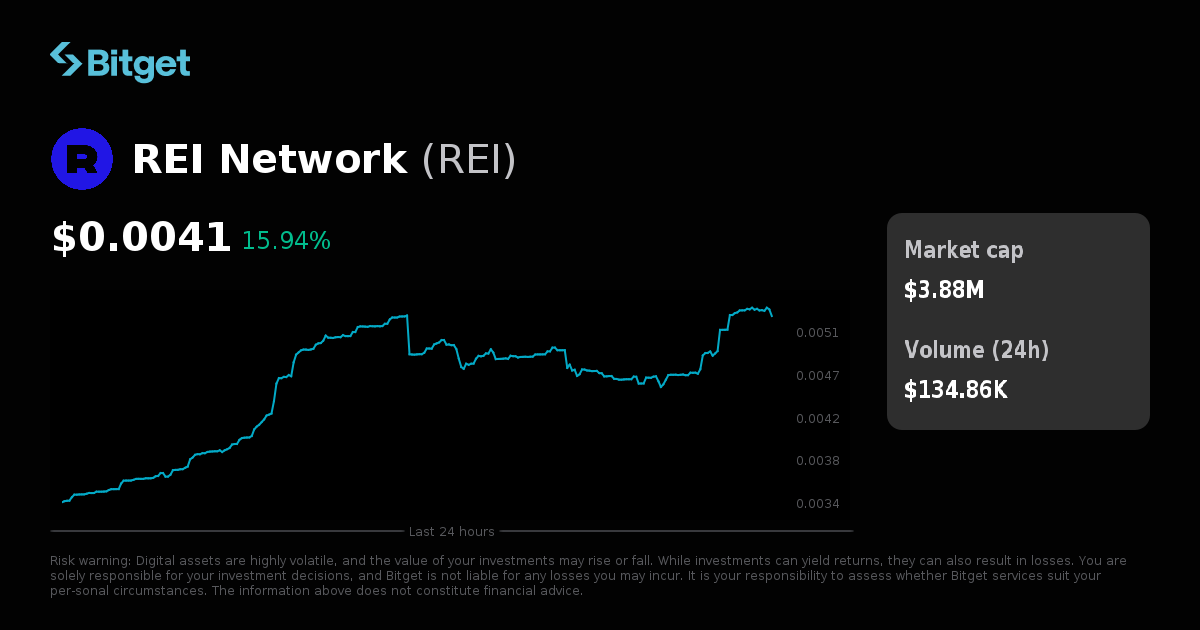
The core value proposition relies on combining token rewards with partner airdrops to boost staking yields. While this mechanism aims to drive demand, the token’s price remains highly sensitive to broader crypto market cycles. Historical data shows REI stabilizing near $0.003, with breakout potential targeting $0.010 only if support at $0.0026 holds firm.
Liquidity limits to account for
As a mid-cap asset, REI faces liquidity gaps during high-volatility periods. Unlike major layer-1s, trading depth can thin out quickly, leading to slippage for larger positions. Investors must weigh the potential upside of the 2025–2026 roadmap against the difficulty of exiting positions without impacting the market price.
Technical Outlook
The technical chart provides a real-time view of market sentiment, highlighting key resistance levels and momentum indicators like RSI. Monitoring these metrics is essential for timing entries, especially as the network integrates new AI-native features that may not yet be fully reflected in fundamental valuations.
Comparison Table
The following table contrasts the primary advantages and disadvantages of holding REI token in the current market environment.
| Factor | Advantage | Risk |
|---|---|---|
| Staking Yields | Boosted by partner airdrops (USDT/BUSD) | Dependent on partner program continuity |
| Network Utility | Gas-free AI-native cross-chain infrastructure | Adoption rates may lag behind roadmap |
| Market Liquidity | Lower entry barrier for small investors | High slippage on large sell orders |
| Price Stability | Strong support at $0.0026 | Downside risk if support breaks |
How to evaluate REI Network for 2026
REI Network is shifting from a standard EVM-compatible chain to an AI-native, cross-chain infrastructure. The 2025–2026 roadmap prioritizes gas-free transactions and smart contract automation for AI agents. To navigate this transition, use this practical framework to assess utility and market fit.
Check if the dApp uses REI’s AI-specific features, such as automated smart contract execution for agent workflows. The network’s value proposition hinges on becoming the settlement layer for AI agents, so prioritize projects that explicitly leverage this capability over generic EVM deployments.
Ensure your intended use case benefits from the network’s gas-free model. This feature is designed to lower barriers for high-frequency AI interactions. If your project relies on simple, low-volume transactions, the standard EVM model may suffice, but for scalable AI operations, REI’s architecture offers a distinct efficiency advantage.
Evaluate how easily assets move across supported chains. The roadmap emphasizes cross-chain interoperability, meaning liquidity should not be siloed. Look for bridge integrations and multi-chain dApps that demonstrate real liquidity flow, as this indicates a healthier ecosystem for staking and utility.
Identifying Misleading Claims and Weak Options
As REI Network positions itself -native, cross-chain infrastructure in 2026, investors must separate genuine utility from marketing noise. The official roadmap outlines a shift toward gas-free transactions and smart contract optimization, but several common claims obscure the actual token value flow [src-serp-2]. Understanding these distinctions is critical for accurate market assessment.
Common Misconceptions About Token Utility
Many promotional materials suggest that combining token rewards with partner airdrops (USDT/BUSD) automatically boosts staking yields. This is a misleading simplification. While the network supports these integrations, the actual yield depends on specific liquidity pools and partner conditions, not a blanket increase. Investors should verify the exact mechanics of any "boost" rather than assuming automatic appreciation.
Weak Options to Avoid
A frequent mistake is treating REI Network merely as a standard EVM chain. The 2025–2026 roadmap explicitly aims to transform it into an AI-native infrastructure, which changes the utility profile. Relying on old EVM-only metrics ignores the new cross-chain capabilities and gas-free features that drive current market growth. Additionally, avoid platforms that promise guaranteed returns from "performance optimization" without detailing the underlying smart contract mechanics.
Concrete Checks for Validity
To filter out weak options, focus on official documentation from rei.network. Look for specific details on how AI-native features interact with the token. If a source claims "robust" growth without citing the Q1 2026 performance metrics or specific partner integrations, treat it with skepticism. Stick to primary sources that provide transparent, verifiable data on staking rewards and cross-chain functionality.
Rei token 2026: what to check next
Investors evaluating REI Network face specific hurdles regarding its transition from a legacy chain to an AI-native infrastructure. The following answers address the practical mechanics, market positioning, and technical realities of the $REI token in the current cycle.
No comments yet. Be the first to share your thoughts!