
Fractional Tokenized Real Estate Ownership for Emerging Market Investors in 2026

For emerging market investors eyeing stable portfolio diversification in 2026, fractional tokenized real estate stands out as a compelling yet precarious gateway. Platforms now slice high-value properties into digital tokens worth as little as $50, thrusting on-chain real estate investing 2026 into the hands of retail participants previously sidelined by capital barriers. But beneath the hype of 308% sector growth lies a web of risks: volatile token liquidity, uneven regulatory enforcement, and blockchain vulnerabilities that demand meticulous scrutiny before commitment.


Tokenization’s Surge in Africa’s Real Estate Landscape
Africa’s capital markets, long starved of inclusive instruments, find tokenization injecting vitality. Sources like International Banker highlight how tokenized real estate Africa enables fractional stakes in premium assets, a rarity for most locals. Platforms fragment properties into thousands of tradeable tokens, each embodying precise ownership shares. Yet, as Tokenizer. Estate notes ahead of 2026,2025’s regulatory pivots worldwide expose nascent African frameworks to exploitation risks. Investors must weigh blockchain’s transparency against off-chain disputes over property titles, a perennial headache in regions with opaque land registries.
Projections paint a bullish picture: ScienceSoft outlines tradeable blockchain tokens fostering shared ownership, while Cotality flags explosive 308% expansion. Still, my risk lens flags over-optimism; secondary markets remain thin, prone to sharp drawdowns during crypto winters.
Latin America and Middle East: Pilots Turning to Production
In Latin America, 2026 marks maturation with active pilots and refining regulations, per Gateway to South America. Binaryx’s global push, tokenizing 25 properties and channeling $4.4 million by mid-2025, exemplifies momentum. Dubai’s REES Phase II unlocks resale for 7.8 million tokens, modeling controlled liquidity for peers. RealT and Lofty lower thresholds to $50, democratizing access amid a market eyeing $4 trillion by 2030, as Nadcab forecasts.
Top 5 Benefits for Emerging Investors
-
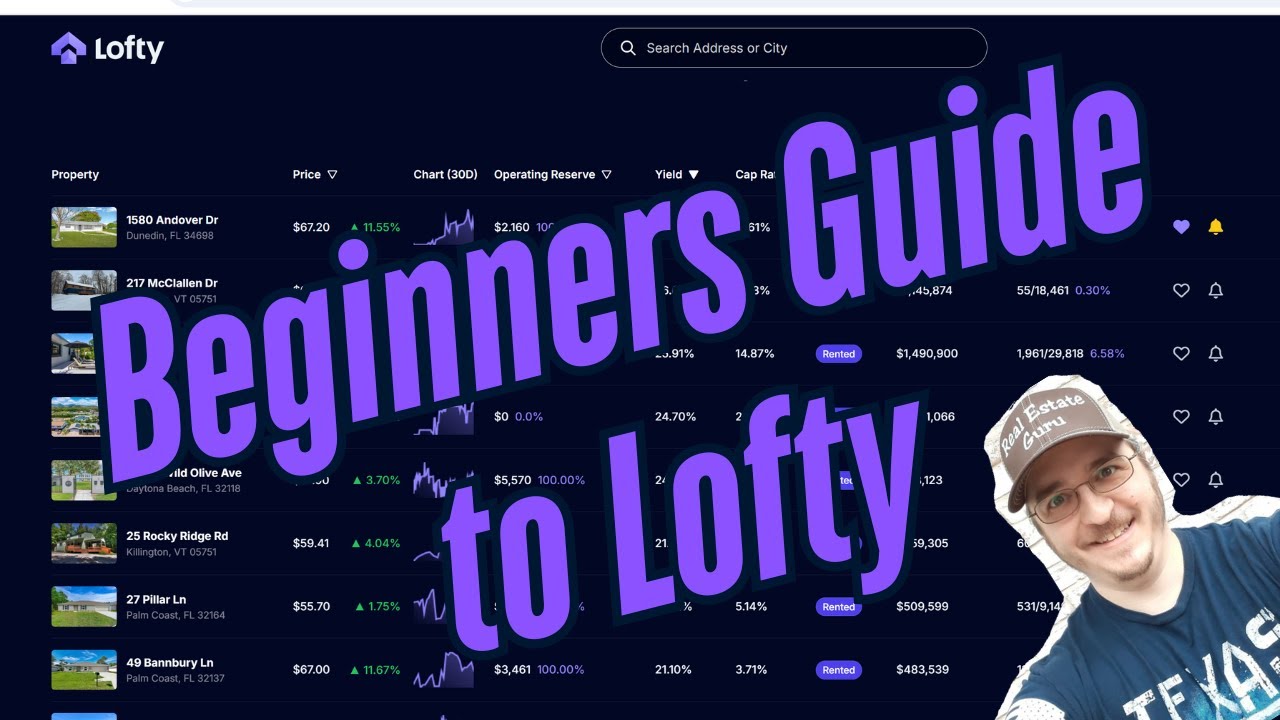
1. Low Entry Barriers: Platforms like RealT and Lofty enable fractional ownership starting at $50, significantly lowering the threshold for emerging market investors previously excluded from high-value properties.
-

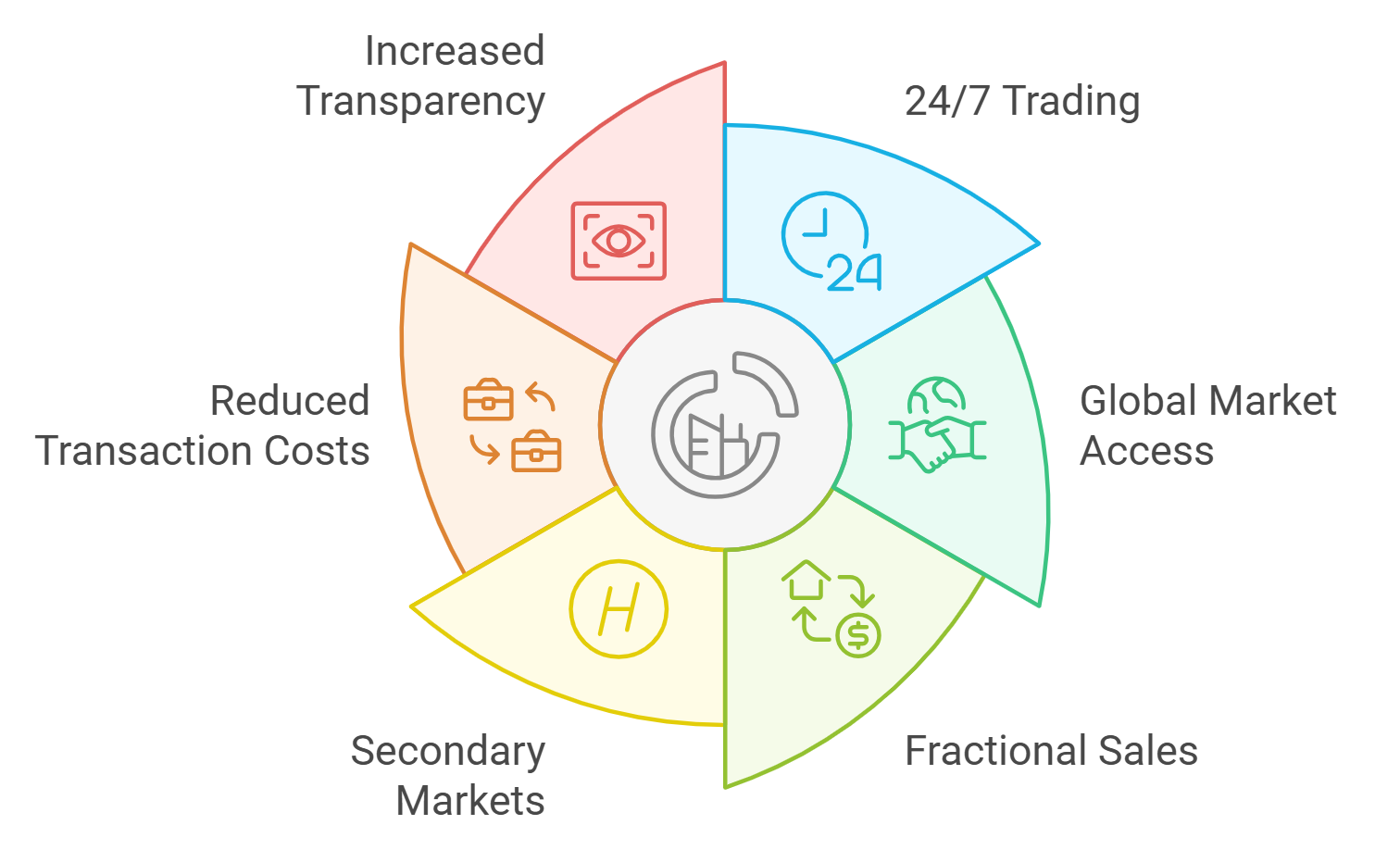
2. Global Liquidity: Tokenized assets trade on secondary markets, such as Dubai’s REES framework enabling resale of 7.8 million tokens, and platforms like Binaryx facilitate cross-border transactions.
-
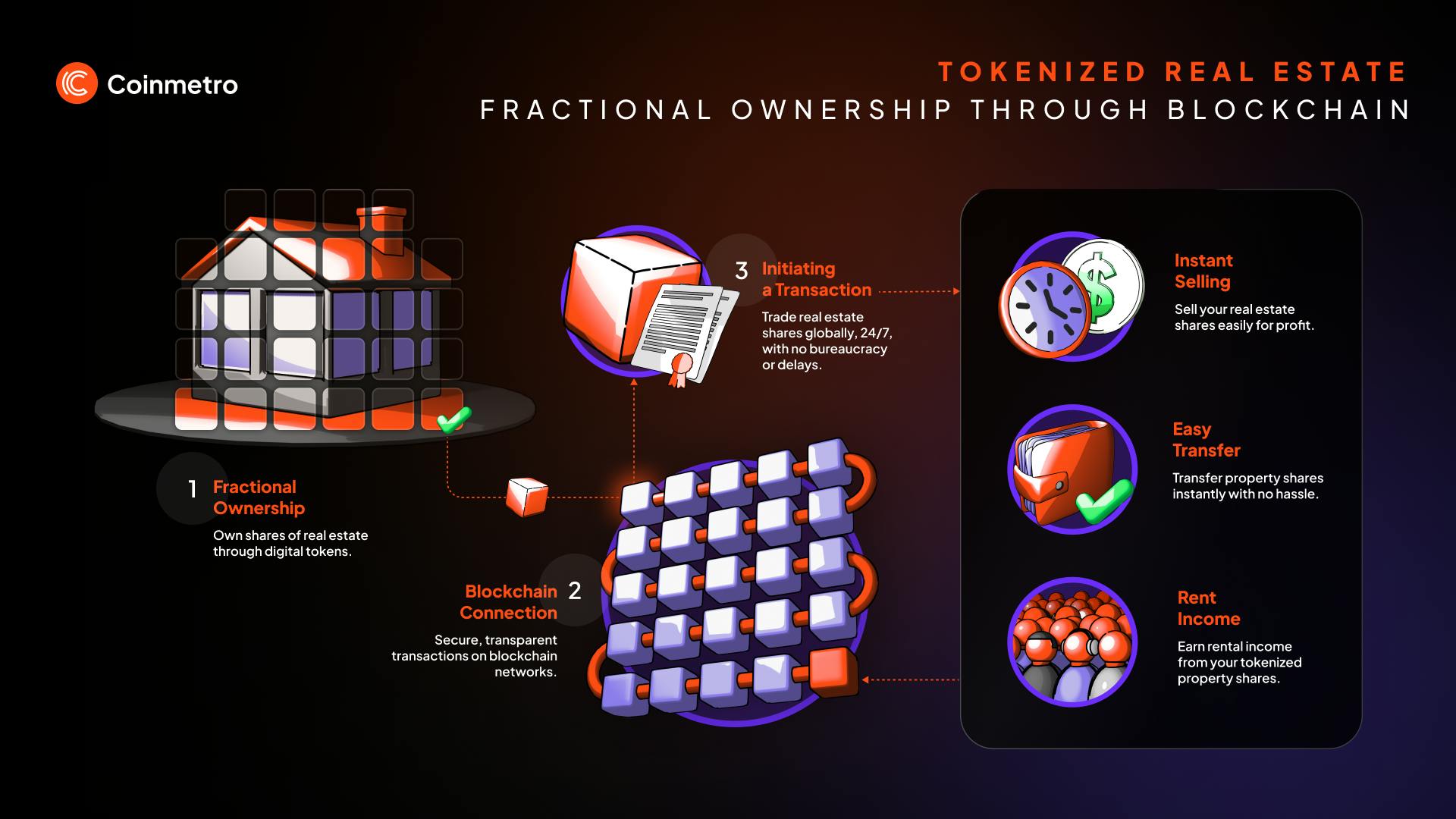
3. Rental Yield Distribution: Investors receive proportional rental income via automated blockchain smart contracts, providing steady passive returns without direct property management.
-
4. Diversification: Fractional tokens allow stakes in international properties across regions like Latin America and Africa, reducing risk through exposure to varied markets as seen on Binaryx.
-
5. Blockchain Transparency: Immutable ledger ensures verifiable ownership and transactions, with regulatory frameworks like UAE’s REES and India’s SEBI guidelines enhancing trust for investors.
These hubs leverage stablecoins for seamless cross-border flows, per RWA. io, simplifying RWA real estate emerging markets. Zoniqx targets 10% of a $500 billion tokenized CRE slice via multi-chain and ESG plays. Regulatory sandsboxes in the USA and SEBI guidelines in India bolster confidence, but emerging locales lag, inviting compliance pitfalls.
Navigating Risks in Blockchain Property Fractional Ownership
Blockchain property fractional ownership tantalizes with liquidity illusions; tokens trade 24/7, unlike illiquid deeds. Charleston Gazette-Mail pegs 2026 as pivotal toward $4 trillion by 2035. Yet, fractionalization mirrors NFT trends at htfmarketinsights. com: divisible yet susceptible to smart contract exploits. Platforms like those in tokenreits. com’s 2026 list prioritize direct tokenization, but oracle failures could misalign token values with physical rents.
From my 15 years spanning real estate and digital assets, the calculus is clear: vet platform audits, assess jurisdictional recourse, and cap exposure at 5-10% of portfolio. Motley Fool underscores lowered barriers, but true returns hinge on rigorous due diligence amid hype.
Emerging market investors must prioritize platforms with proven audits and transparent governance. Binaryx’s track record, processing $4.4 million across 25 properties, signals viability, yet its global expansion invites currency volatility in non-stablecoin trades. RealT and Lofty maintain $50 entry points, channeling rental yields directly on-chain, but oracle dependencies for rent distribution pose misalignment risks during economic downturns.
Benchmarking Platforms for Fractional Tokenized Real Estate
Selecting the right conduit demands methodical comparison. Zoniqx’s ESG integration and multi-chain ambitions target commercial real estate dominance, while Dubai’s REES framework offers a blueprint for secondary liquidity. Yet, as tokenization lowers barriers, liquidity premiums evaporate in bear phases, amplifying drawdowns beyond traditional REITs.
Comparison of Top Platforms for Fractional Tokenized Real Estate Ownership in Emerging Markets (2026)
| Platform | Minimum Investment | Geographic Focus | Key Features | Notable Stats (2026) |
|---|---|---|---|---|
| RealT | $50 | US/Europe | Rental yields | Pioneered low-entry fractional ownership |
| Lofty | $50 | Global residential | Automated dividends | Democratizes access for emerging investors |
| Binaryx | Varies | International expansion | Fractional ownership of properties | 25 properties tokenized, $4.4M+ in investments |
| Zoniqx | N/A | Commercial Real Estate (CRE) | ESG-focused, multi-chain | Targets 10% of $500B tokenized CRE market |
This matrix underscores diversification imperatives: blend residential yields with commercial upside, but cap any single platform at 20% allocation to mitigate platform-specific failures.
Projecting Growth Amid Uncertainty
Market forecasts tempt aggression, with $4 trillion tokenized real estate by 2030 per Nadcab, accelerating fractional tokenized real estate adoption. Stablecoins streamline settlements, per RWA. io, yet macroeconomic headwinds like rising rates could compress cap rates, devaluing underlying collateral. My frameworks stress stress-testing: model 30% token price corrections tied to crypto sentiment, independent of physical asset performance.
REALT (REALT) Price Prediction 2027-2032
Projections for tokenized real estate RWA token amid $4T market growth by 2030 and 308% sector expansion, tailored for emerging market investors
| Year | Minimum Price | Average Price | Maximum Price | Avg YoY % Change |
|---|---|---|---|---|
| 2027 | $0.20 | $0.45 | $0.80 | +80% |
| 2028 | $0.35 | $0.90 | $1.60 | +100% |
| 2029 | $0.60 | $1.50 | $2.80 | +67% |
| 2030 | $1.00 | $2.50 | $4.50 | +67% |
| 2031 | $1.50 | $3.80 | $6.50 | +52% |
| 2032 | $2.00 | $5.50 | $9.00 | +45% |
Price Prediction Summary
REALT is forecasted to experience substantial growth driven by the tokenized real estate boom, with average prices climbing from $0.45 in 2027 to $5.50 in 2032—a cumulative increase of over 1,100%. Minimum prices represent bearish market cycles and regulatory hurdles, while maximums capture bullish adoption in emerging markets, regulatory clarity, and $4T sector expansion. Predictions factor in crypto market volatility, RWA utility enhancements, and competition from tokens like LOFTY and ZONIQX.
Key Factors Affecting REALT Price
- 308% sector growth exploding demand for RWA tokens like REALT
- Fractional ownership democratizing real estate access in Africa, Latin America, and UAE
- Regulatory advancements including Dubai’s REES Phase II and SEC sandboxes
- $4T tokenized real estate market projection by 2030 boosting platform tokens
- Multi-chain expansions and ESG-focused offerings by leaders like Zoniqx and RealT
- Global platforms like Binaryx tokenizing properties and enabling liquid secondary markets
- Stablecoin integration simplifying cross-border investments in emerging markets
Disclaimer: Cryptocurrency price predictions are speculative and based on current market analysis.
Actual prices may vary significantly due to market volatility, regulatory changes, and other factors.
Always do your own research before making investment decisions.
Latin America’s pilots evolve into production-scale operations, bolstered by regulatory tailwinds, while Africa’s opaque titles necessitate hybrid on-off-chain verification. Investors fluent in blockchain property fractional ownership gain edges, but novices face steep learning curves on wallet security and tax implications across jurisdictions.
Operational resilience defines winners. Platforms embedding KYC with blockchain pseudonymity navigate compliance mazes, yet smart contract immutability locks in early flaws. From commodities to digital assets, I’ve seen cycles where liquidity mirages precede 70% retracements; tokenized real estate is no exception.
Building a Resilient Allocation Strategy
Commence with asset selection: target income-generating properties in inflation-hedged locales like UAE outposts or Brazilian urban cores. Allocate via dollar-cost averaging over 6-12 months to average entry volatility. Monitor via dashboards tracking occupancy, yield attribution, and token-to-asset NAV ratios; deviations exceeding 5% warrant exits.
Layer hedges: pair with stablecoin yields or inverse crypto positions during euphoria peaks. Recourse mechanisms vary; Dubai’s REES enforces resales, but African ventures lean on DAO governance, prone to factionalism. Annual reviews recalibrate based on global rate trajectories and blockchain throughput upgrades.
For the methodical investor, tokenized real estate complements equities and commodities, offering yields at 6-10% net of fees, provided exposures stay measured. Platforms evolve, regulations solidify, yet the core tenet endures: interrogate liquidity assumptions rigorously. Risk frameworks, rigorously applied, unlock the sector’s promise without courting ruin.